

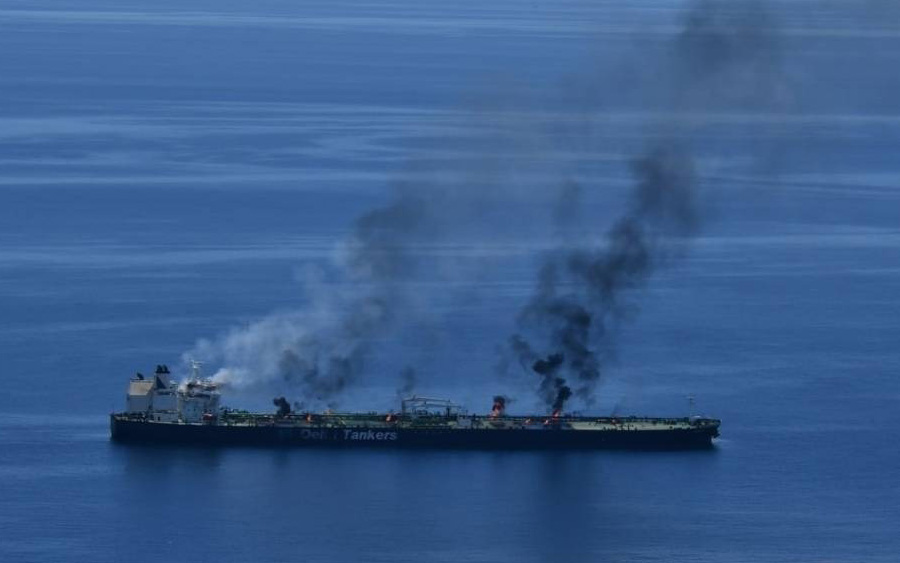
A seafarer was killed and three others were injured in a drone attack on the Turkish-flagged MV Reyhan Sarı in the Black Sea. This was not an isolated incident; it is the latest in a dangerous series of events in which civilian ships and seafarers are increasingly being drawn into war, from the Black Sea to the Red Sea and from the Strait of Hormuz to Ukrainian ports. DAD-DER once again stresses: seafarers are not parties to wars, and merchant ships must not be turned into military targets.
The Turkish-flagged MV Reyhan Sarı, carrying coal from Russia’s Port of Taman to Trabzon, was attacked by an unmanned aerial vehicle in the Black Sea. According to initial reports, a Turkish seafarer working in the engine room was killed and three other seafarers were injured. The vessel sustained damage.
There has not yet been a detailed, verified official statement on the precise location of the attack or on which party carried it out. The results of the investigation must therefore be awaited before responsibility can be determined conclusively. But one thing is certain: another seafarer has lost his life while working in the midst of a war to which he was not a party.
We extend our condolences to the family and colleagues of the seafarer who lost his life and wish the injured seafarers a speedy recovery.
The Black Sea Is No Longer Merely a “Risk Area”; It Is an Active War Zone
Since the Russia–Ukraine war began in February 2022, numerous merchant vessels in the Black Sea and the Sea of Azov have been struck by missiles, mines, drones and uncrewed surface vessels. The security boundaries between ports, cargo terminals, anchorages and ships under way have steadily disappeared.
Attacks intensified dramatically in July 2026 in particular:
- On 13 July, three seafarers were killed and five were injured in an attack on a Togo-flagged merchant vessel in the Odesa region.
- On 16–17 July, the merchant vessel ASOMATOS, off Russia’s Kavkaz region, was struck by drones; one seafarer was killed.
- On 17 July, at least four foreign-flagged merchant vessels were damaged in the port areas of Mykolaiv and Odesa. Two people aboard one vessel were killed, while four crew members on another vessel were injured.
- On 20 July, the bulk carrier Golden Leo, off Odesa, was struck by three cruise missiles. Nine of the vessel’s 17 crew members and a Ukrainian maritime pilot were killed. Eight seafarers were rescued. This was one of the deadliest attacks on a merchant vessel in recent times.
- On 22 July, the Turkish-flagged MV Reyhan Sarı was attacked; one seafarer was killed and three were injured.
Thus, in the verified incidents between 13 and 22 July alone, at least eight civilian merchant vessels were struck or seriously damaged; 16 seafarers and one maritime pilot were killed, and at least 12 seafarers were injured. These figures do not include port workers, fishers, personnel aboard vessels used for military purposes, or attacks for which sufficient information is unavailable.
In a statement issued on 13 July, the International Maritime Organization (IMO) also noted the renewed escalation of attacks in the Black Sea and the Sea of Azov and called for all attacks on civilian merchant vessels to cease. As the IMO has stated, these attacks threaten not only ships, but also seafarers’ lives, navigational safety and global supply chains.
The Picture Is No Different in the Red Sea and the Strait of Hormuz
The involvement of seafarers in wars is not confined to the Black Sea.
According to IMO records, at least 55 separate incidents were recorded in the Red Sea between November 2023 and July 2025. The ITF, meanwhile, reports more than 300 attempted attacks on vessels between November 2023 and December 2024, with two vessels sunk and one hijacked. The figure “more than 300” does not mean that 300 separate ships were hit; it refers to the total number of hostile acts, including missile attacks, drone attacks and armed interventions.
At least eight seafarers in total were killed in the attacks on True Confidence, Tutor, Eternity C and Minervagracht, and many others were injured. The crew of Galaxy Leader was held hostage for more than a year.
As the war spread to Iran and the Strait of Hormuz in 2026, maritime workers were once again pushed into the line of fire. In July, the tankers Mombasa B and Al Bahiyah were struck, leaving one Indian seafarer dead, eight seafarers injured and three people missing. After two of its citizens were killed in separate attacks, India decided that Indian seafarers should not be assigned to vessels transiting the Strait of Hormuz.
These incidents show that those who speak of keeping global trade moving often render invisible the lives of the people who actually make that trade possible. Oil prices, freight rates, insurance premiums and delivery times are debated for hours, while seafarers working in engine rooms, on bridges and on decks under the threat of missiles and drones are reduced to mere statistics.
The ITF’s Position: Seafarers Are Not the “Inevitable Casualties” of War
In a statement issued on 14 July, the International Transport Workers’ Federation (ITF) condemned the attacks in both the Black Sea and the Strait of Hormuz and called on all parties to guarantee safe passage for civilian vessels.
As ITF General Secretary Stephen Cotton has stressed, seafarers are being put directly in the line of fire in wars they did not start. Working thousands of kilometres from their families, seafarers are paying the price of conflicts between states, armed forces and powerful commercial interests.
Under the latest decision of the International Bargaining Forum (IBF), which brings together the ITF and employers’ organisations, the following areas were designated as Warlike Operations Areas or High Risk Areas as of 9 July 2026:
- The Sea of Azov and the Kerch Strait;
- the northern Black Sea region;
- all ports in Ukraine;
- designated high-risk areas in the Black Sea;
- the southern Red Sea and the Gulf of Aden;
- the Persian Gulf, the Strait of Hormuz and the Gulf of Oman;
the ports of Israel and Lebanon, together with designated offshore areas, are classified as an Extended Risk Zone.
Seafarers serving aboard vessels covered by ITF agreements must be informed before entering a Warlike Operations Area or High Risk Area. Depending on the agreement and the area’s designation, these seafarers have the right to:
- refuse to enter a war zone;
- decline the assignment without losing their job or facing any penalty;
- be repatriated at the company’s expense;
- receive compensation equal to two months’ basic wages;
- receive a war-zone bonus for the time spent in the area;
- receive double compensation in the event of death or permanent disability.
The ship operator must also implement enhanced security measures equivalent to ISPS Level 3. Detailed information on seafarers’ rights and companies’ obligations is available here.
There is, however, a serious inequality: these protections are clearest and most enforceable on vessels covered by ITF agreements. Seafarers working without an agreement, under a flag of convenience (FOC), or without trade union organisation against their employer are often left with little more than general rules on paper.
As DAD-DER/ITF, we set out our demands as follows:
- All attacks on merchant and civilian vessels, fishing vessels, ports and maritime workers must cease immediately. A vessel’s cargo, flag, ownership structure or inclusion on sanctions lists does not turn its seafarers into military targets.
- The free and informed consent of the seafarer must be the governing principle in war zones and high-risk areas. Consent obtained under threat, dismissal, blacklisting or fear of losing wages cannot be regarded as valid.
- The seafarer’s right to refuse to enter a dangerous area must be guaranteed on all vessels. This right must not be limited to seafarers covered by ITF agreements.
- Where an alternative and safer route is available, companies must not send their vessels into a war zone. Higher fuel, time, freight or insurance costs are not worth more than a human life.
- War-zone bonuses, death and disability compensation, free repatriation and job security must be implemented in full. Employers must cover all medical treatment and rehabilitation costs for injured seafarers, and support must be provided to their families without delay.
- Attacks must be independently investigated and the findings made public. A shared and transparent international database must be established for vessels struck and for seafarers killed, injured or missing.
- Diplomatic channels must be opened to end the wars and achieve lasting peace. The real guarantee of maritime workers’ safety is not more armament, but an end to the conflicts.
Death Cannot Be Normalised While Cargo Keeps Moving
Around 80 per cent of world trade is carried by sea. From energy and food to medicines and industrial raw materials, the functioning of the global economy depends on seafarers’ labour. Yet when war breaks out, they are once again among the first to be treated as expendable.
Seafarers are not parties to wars. Merchant ships are not targets. No cargo, no freight revenue and no company profit is worth more than a seafarer’s life.